Hilbert’s Program
From the prestigious University of Göttingen, David Hilbert developed his own foundational system for arithmetic and, ultimately, for mathematics as a whole. This is known as Hilbert's Program, to which this article is dedicated.
David Hilbert
By the end of the nineteenth century, David Hilbert was already a highly respected mathematician. Working at the University of Göttingen, which had welcomed and continued to welcome so many distinguished scholars, Hilbert became one of the leading figures in German mathematics and, consequently, in the world.
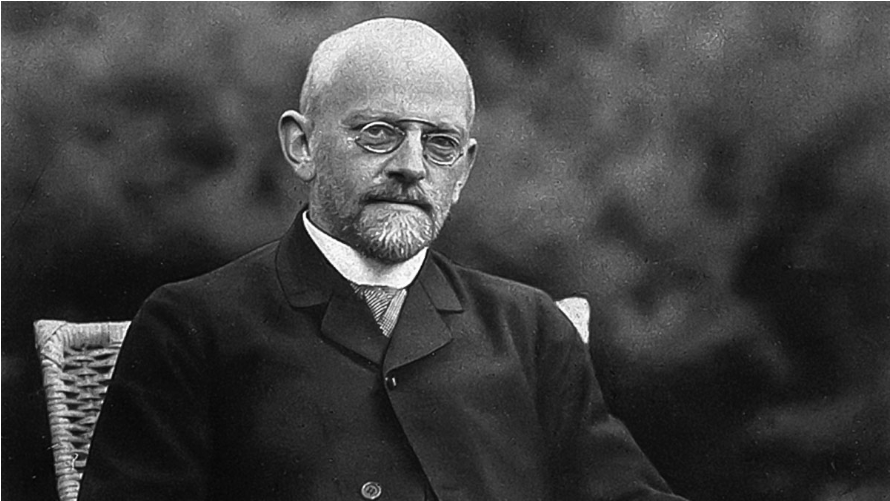
A scientist of his stature could not ignore the foundational movement sweeping through mathematics during the 1880s and 1890s and, inevitably, he joined it. In 1899 Hilbert published one of his major works: Grundlagen der Geometrie, or Foundations of Geometry. Hilbert was reviving Euclid’s ancient project of establishing the foundations of geometry.
The use of the axiomatic method was not in itself new. Like Euclid more than two thousand years earlier, the German mathematician employed a finite collection of axioms, or fundamental principles, on which to base an entire mathematical theory. These axioms formed the foundations from which the characteristic theorems of geometry were derived. Hilbert also studied the independence of the different axioms—that is, whether any one of them could be derived from the others.
Hilbert’s great innovation lay in the precision and abstraction with which he applied this method. Fundamental terms such as “point,” “line,” or “plane” did not need to possess a predetermined intuitive meaning: they were characterized by the relations established in the axioms.
Over the years Hilbert refined this method, regarding it as the most systematic and rigorous way to present a branch of mathematics. Although his interest in the foundations of arithmetic emerged during the closing years of the nineteenth century, it was during the 1920s that his project acquired its full rigor and depth.
Hilbert’s Program
Once Hilbert had succeeded in providing a formal and precise foundation for geometry, he faced the need to extend his axiomatic method to other branches of mathematics. The proof of the consistency of his geometrical system rested on arithmetical assumptions: any contradiction in geometry could have been translated into a contradiction within arithmetic.
The necessary next step was therefore an equally formal and precise foundation for arithmetic. Yet those same arithmetical assumptions could no longer be used to prove their own consistency without falling into circular reasoning. A different route had to be taken, and during the early years of the century Hilbert made several attempts to provide a solution. Like Frege before him, he faced the task of establishing arithmetic—and, through it, large parts of mathematics—on rigorous foundations. This would become the aim of Hilbert’s Program.
Hilbert’s Formalism
Unlike Frege and Russell, Hilbert held that a rigorous presentation of mathematics required certain elementary notions and objects to be given intuitively to thought. Logical principles could not serve as a foundation on their own unless they were applied to concrete and directly recognizable objects, such as finite signs and sequences of signs. Hilbert thus distanced himself from the strict logicist project.
– We hold fast, against the earlier efforts of Dedekind and Frege, to the conviction that if scientific knowledge is to be possible, certain intuitive conceptions and insights are indispensable; logic alone is not sufficient. –
David Hilbert. Über das Unendliche. 1926.
Although he acknowledged that the most elementary foundations of mathematics rest on our intuitive understanding, Hilbert insisted that we could not stop there and that a sufficiently refined method was required to study them. Mathematical reasoning had to be formalized so that it could meet the highest standards of precision and rigor.
The axioms underpinning a theory had to state explicitly the ways in which its primitive notions could and could not be related to one another. The rules of inference also had to specify which transformations could legitimately be performed on formulas.
This insistence on rigor became the defining hallmark of Hilbert’s scientific work, to the point that his critics would accuse him—perhaps with some exaggeration—of reducing mathematical reasoning to a blind game of symbol manipulation. Hilbert did not, however, claim that all mathematics was devoid of meaning: he distinguished between an elementary, intuitive part and an ideal part whose legitimacy had to be secured by a consistency proof.
The Axiomatic Method
Any scientific theory, even outside mathematics, can be conceived as a conceptual structure formed by a collection of propositions related to one another according to logical principles. Hilbert observed that among these propositions there are some from which the entire system can be reconstructed. These are the axioms of the theory: propositions that are not proved within the system but from which its remaining propositions are proved.
– The procedure of the axiomatic method, as expressed here, amounts to a deepening of the foundations of the domains of knowledge—a deepening required by any edifice that one wishes to expand and raise higher while preserving its stability. –
– David Hilbert. Axiomatisches Denken. 1918.
These axioms had to undergo an exhaustive study to determine whether they met a number of requirements. Chief among them were that they be independent of one another—that is, that none could be derived from the others—and consistent, meaning that they did not allow contradictions to be derived.
The axiomatic system devised by Zermelo for set theory provides an example of this latter requirement. The discipline had been troubled by paradoxes such as the Burali-Forti paradox, concerning the supposed totality of all ordinals. Zermelo’s axioms restricted the operations by which sets could be formed and blocked the known paradoxes.
Yet blocking contradictions that had already been discovered was one thing; proving that no contradiction could ever be derived from the axioms was another. Hilbert had not provided an absolute proof of the consistency of geometry either: he had reduced its consistency to that of arithmetic. The new requirement was to prove the consistency of arithmetic itself without presupposing methods whose legitimacy depended on arithmetic.
The Consistency of Arithmetic
Hilbert’s Program approached the issue from a perspective that was, to some extent, novel. The problem of foundations was to be treated primarily as a problem of consistency: given a collection of axioms for arithmetic, it had to be shown that no proposition and its negation could both be derived from them.
Hilbert closely connected mathematical existence with consistency. If the axioms characterizing a particular class of objects do not lead to contradiction, those objects may be regarded as mathematically legitimate within the theory. If the system allows a contradiction to be derived, it does not constitute an acceptable mathematical theory.
It was not enough, however, to formalize the axioms and declare that they appeared consistent. A consistency proof had to be supplied using finitary procedures: elementary forms of reasoning applied to finite signs and configurations whose correctness could be recognized directly.
A formalized theory transforms mathematical propositions and proofs into finite sequences of signs. The aim was to show, by studying those sequences as mathematical objects, that none of them could constitute a proof of a contradiction such as \(0=1\).
Unlike some of his contemporaries, Hilbert remained faithful to Cantor’s discoveries. Transfinite numbers, the continuum, and non-constructive methods were to be preserved within classical mathematics. It was not necessary to construct each of their objects intuitively, as Brouwer demanded, provided that their use could be shown not to lead to contradiction.
The consistency Hilbert sought concerned more than elementary arithmetic. The program also aimed to justify analysis and those parts of set theory used in classical mathematics. Infinite objects could belong to this ideal mathematics, provided that their incorporation was shown to be safe.
In summary, Hilbert’s Program can be condensed into two objectives: first, the systematization of mathematical theories through rigorously defined axioms and rules of inference; and second, a finitary proof that these formal systems are consistent and do not permit contradictions to be derived.
Metamathematics and Hilbert’s Program
This proposal for grounding mathematics shifts attention away from the content of a theory and toward the formal structure of the propositions, axioms, and proofs that compose it. We can then ask questions about that structure: is it consistent, meaning free from contradiction? Is it complete, so that for every proposition expressible in the system either the proposition or its negation can be proved? Is it decidable, meaning that there is an effective procedure capable of determining in a finite number of steps whether a formula is a theorem?
For a more extensive discussion of these kinds of metaproperties, we recommend the following article in the Mathematical Logic series.
Although questions of this kind had already occupied the attention of many mathematicians, Hilbert and his school systematized them within a new field of study known as metamathematics. Hilbert recognized that many of the deepest debates about foundations depended on resolving general properties of mathematical theories, rather than merely internal problems within a particular discipline.
Metamathematics thus distinguishes between two levels. At the first is the formalized mathematical theory, with its signs, axioms, and rules. At the second, we study that theory as an object: we examine its formulas, its proofs, and the properties of the system as a whole.
Proof Theory
Metamathematics arises naturally once a branch of knowledge has been formalized within a framework in which all propositions are derived according to explicit rules of deduction. Without abandoning the discovery of new theorems, we can take the very mechanism of proof as a new object of study.
A formal proof can be represented as a finite sequence of formulas. Each formula must either be an axiom or follow from earlier formulas by an accepted rule of inference. We can then ask precise questions: how can we ensure that the theorems obtained are compatible with the rest of the theory? Can we determine whether there are propositions that our system is unable to prove? Is there a method capable of recognizing every correct proof?
These and other questions were among the great problems that Hilbert believed had to be solved in order to secure the foundations of mathematics. If we could prove by finitary methods that the rules of deduction applied to the axioms never produce a contradiction, we would have justified the use of the formal theory, as Hilbert’s Program sought to do.
Proof Theory, the mathematical study of formal proofs, will be the subject of our next article.
Recommended Reading
– Hilbert, D. (1900). Mathematische Probleme (“Mathematical Problems”).
– Hilbert, D. (1918). Axiomatisches Denken (“Axiomatic Thought”).
– Hilbert, D. (1922). Neubegründung der Mathematik. Erste Mitteilung (“The New Grounding of Mathematics: First Report”).
– Hilbert, D. (1926). Über das Unendliche (“On the Infinite”).