Frege’s Arithmetic
Gottlob Frege—mathematician and philosopher in equal measure—initiated a profound re-examination of the most fundamental notions of mathematics. In this article, we will focus on his project to reconstruct arithmetic and the fundamental concept of number from a logicist standpoint, as we previously indicated.
Gottlob Frege and Logicism
In this article, we will take as our reference the Grundlagen der Arithmetik (“The Foundations of Arithmetic”), as well as the last of Frege’s major works: Grundgesetze der Arithmetik (“Basic Laws of Arithmetic”). These works pursue several aims. Frege seeks to provide a precise account of the number concept using the resources of formal logic, in keeping with the program known as logicism. His goal is not merely to propose a definition, but to derive the basic laws of arithmetic, including the properties of addition, multiplication, and numerical succession.
We discussed in the previous article why Frege chose Arithmetic as the discipline to be placed on rigorous foundations: he considered arithmetical truths to possess an exceptional degree of generality, because they apply to everything that can be counted or conceived under the aspect of numerability.
Logic and Mathematics
As he had already argued in earlier works, Frege defends an analytic conception of Arithmetic: mathematical theorems are to be derived from precise definitions and general logical laws. Analysis, understood in this way, conceives mathematical notions as emerging from universal principles of thought. Frege did not, of course, understand thought as an actual cognitive act dependent on psychophysiological conditions. For him, these principles are instead standards governing how thought ought to proceed and determining necessary deductions. Such standards transcend every individual act of thinking: they are laws of inference itself and are therefore analytic. Thus, as Frege conceives them, numbers are abstract objects belonging to a realm distinct from both the external world and the mental world, and owing nothing to either.
Concepts and Objects
In the Grundlagen, Frege introduces a notion that will become central to his system: the concept (Begriff). Frege’s extensive body of work, developed throughout his life, progressively refines this notion, especially by connecting it with the notion of function. For the time being, we will understand a concept as an expression concerning an indeterminate object, such as “\(x\) is the capital of a country” or “\(x=4\).” As we can see, a concept is the unsaturated part waiting to receive an argument. Only when the variable \(x\) is replaced by a specific value (“Seoul is the capital of a country” or “\(6=4\)”) does the concept yield a statement that may be true or false. There may also be second-order concepts, which are saturated by other concepts. In such cases, the argument is denoted by \(X\). For example: “\(X\) is a concept that describes characteristics of a country.”
What Are Numbers?
Principle of Abstraction
When we say that there are twelve constellations of the Zodiac and twelve disciples of Christ, we use the same number in very different contexts. But what exactly does it mean for both concepts to have the same number? What do concepts as different as “x is a constellation of the Zodiac” and “x is a disciple of Christ” have in common?
A first answer is that numerical attributions do not apply directly to individual objects, but to concepts. We do not say that a particular disciple is “twelve”; rather, we say that the concept “x is a disciple of Christ” has twelve objects falling under it. In this sense, expressions such as “being twelve,” “being seven,” or “having no elements” function as second-order properties: they do not apply to objects, but to concepts under which objects fall. This observation, however, is not yet sufficient to explain what a number is. For Frege, numbers are not merely properties of concepts, but abstract objects. The decisive question is therefore how we can move from a relation between concepts—for example, that two concepts have just as many objects falling under one as under the other—to the introduction of a shared abstract object: the number.
This is the role of a principle of abstraction. A principle of abstraction starts from an equivalence relation and turns it into a criterion of identity for new abstract objects. It does not merely group similar cases together, but establishes when two different ways of presenting something refer to the same object. In the case of numbers, the relevant relation will be equinumerosity: two concepts have the same number when the objects falling under one can be paired with those falling under the other, with neither surplus nor deficit. Before applying this idea to numbers, however, Frege introduces a simpler example drawn from geometry: the direction of a line.
Equivalence and Identity
Frege illustrates how abstraction works through the case of parallel lines. We can compare two lines, \(a\) and \(b\), with respect to a specific relation: being parallel. We write this relation as \(a \parallel b\). Parallelism is an equivalence relation: a line is parallel to itself; if \(a\) is parallel to \(b\), then \(b\) is parallel to \(a\); and if \(a\) is parallel to \(b\), and \(b\) is parallel to \(c\), then \(a\) is parallel to \(c\). Thanks to these properties, parallelism allows us to group lines that share the same direction. The abstractive step consists in introducing a new object: the direction of a line. We do not identify the lines themselves, since two distinct lines may be parallel. What we identify is their direction. Thus, we say that the direction of \(a\), which we may denote by \(D(a)\), is equal to the direction of \(b\), \(D(b)\), if and only if the two lines are parallel:
$$D(a)=D(b) \leftrightarrow a \parallel b$$
The equivalence relation “being parallel” is thereby transformed into a criterion of identity for abstract objects: directions. Two lines may be distinct while having the same direction. Equality is no longer asserted between the lines themselves, but between the abstract objects obtained from them.
Hume’s Principle
Starting from two concepts such as “\(x\) is one of the Wonders of the Ancient World” and “\(x\) is a musical note,” what criterion of equivalence would allow us to form the concept of the number seven? In the case of numbers, the relevant criterion of equivalence is not parallelism, but equinumerosity: the possibility of pairing the objects falling under the two concepts so that none remains unmatched. If two concepts are equinumerous, then the number belonging to one is the same as the number belonging to the other. Thus, we may say that the number \(\theta\) of a concept \(P\) is equal to the number of a concept \(Q\) if and only if \(P\) and \(Q\) are equinumerous (denoted by the symbol \(\sim\))
$$\theta (P) = \theta (Q) \leftrightarrow P \sim Q$$
This is known as Hume’s Principle, owing to its attribution to the famous British philosopher. As we saw in previous articles, equinumerosity was the basis from which Cantor developed the concept of cardinal number. Hume’s Principle establishes an equivalence between the equality of operators of the form “the number of a concept” and the equinumerosity of concepts.
Contextual Definitions
Hume’s Principle appears to offer an elegant way of introducing numbers into the logical system. Instead of beginning by asking what the numbers \(7\), \(12\), or \(0\) are when taken in isolation, Frege proposes that we attend to how they appear within identity statements. Thus, we do not first define what “the number of \(P\)” is, but rather when two expressions of the form “the number of \(P\)” and “the number of \(Q\)” designate the same thing. \(\theta P\) means “the number of the concept \(P\),” and \(P\sim Q\) means that the concepts \(P\) and \(Q\) are equinumerous: the objects falling under \(P\) can be paired one-to-one with the objects falling under \(Q\), with none left over or missing. The expression \(\theta P\) is therefore not a predicate asserting something on its own, but a singular term: it purports to name an object, namely the number belonging to the concept \(P\).
This type of definition is known as a contextual definition. Its characteristic feature is that it does not introduce an object directly through an explicit definition, but instead fixes the conditions under which certain expressions containing it may be regarded as equal. In this case, the principle tells us when two numerical terms have the same referent: “the number of \(P\)” is equal to “the number of \(Q\)” if and only if \(P\) and \(Q\) are equinumerous.
This strategy, however, leaves an important difficulty unresolved. Hume’s Principle allows numbers to be compared with one another when both are presented as numbers of concepts. It tells us, for example, when “the number of the disciples of Christ” is equal to “the number of the constellations of the Zodiac.” It does not, however, explain how to compare a number with an arbitrary object in the logical system that has not been presented as the number of a concept. The contextual definition fixes identities of the form \(\theta P=\theta Q\), but does not directly determine what happens in mixed expressions such as \(\theta P=q\), where \(q\) may be any object whatsoever. And if numbers are to be genuine objects, it is not enough to know when two numbers are equal to one another: it must also be determined what distinguishes them from every other object.
The Julius Caesar Problem
This difficulty is what Frege calls the Julius Caesar Problem. Hume’s Principle allows us to decide when two concepts have the same number, but it does not allow us, on the basis of that principle alone, to decide whether an arbitrary object is or is not a number. For example, it provides no rule for determining the truth value of an expression such as:
$$\theta P=\text{Julio César}$$
Naturally, we know that Julius Caesar is not a number. But Frege’s concern is neither psychological nor historical, but logical: a satisfactory definition of number should allow us to exclude this possibility from within the system itself. It should not depend on an external intuition about who Julius Caesar was or what kind of object he appears to be.
The problem arises because Hume’s Principle establishes identity conditions only between numerical terms. If we have “the number of \(P\)” and “the number of \(Q\),” the principle tells us that they are equal when \(P\) and \(Q\) are equinumerous. But if one side of the identity does not have the form “the number of a concept,” the principle does not apply. Frege therefore regards it as insufficient to introduce numbers solely through a contextual definition. An adequate theory must explain what numbers are as objects and must establish identity conditions that allow them to be compared with any other object in the system. Only then can numbers be said to have been defined with full logical precision.
Concepts and Extensions
In his final and definitive work, the Grundgesetze der Arithmetik, Frege clarifies the logicist project through a much more formal presentation of its basic notions, above all that of concept. A concept is a particular case of the more general notion of a function: one that maps each argument to one of two possible truth values: “true” or “false.” We say that objects fall under a concept when the concept returns the truth value “true.”
Extension
Intuitively, we may think of an extension as corresponding to the objects that fall under a concept, which offers a set-theoretic perspective on the matter. More faithfully to Frege, however, it is better understood as the mapping or assignment of the values “true” and “false” to the different objects that may serve as arguments for the concept. Thus, the concept “\(x\) is a Galilean moon” has an extension: {Io, Callisto, Ganymede, Europa}, because these are the objects for which it returns the value “true.” For a concept \(Q\), we denote its extension by \(\varepsilon Q\).
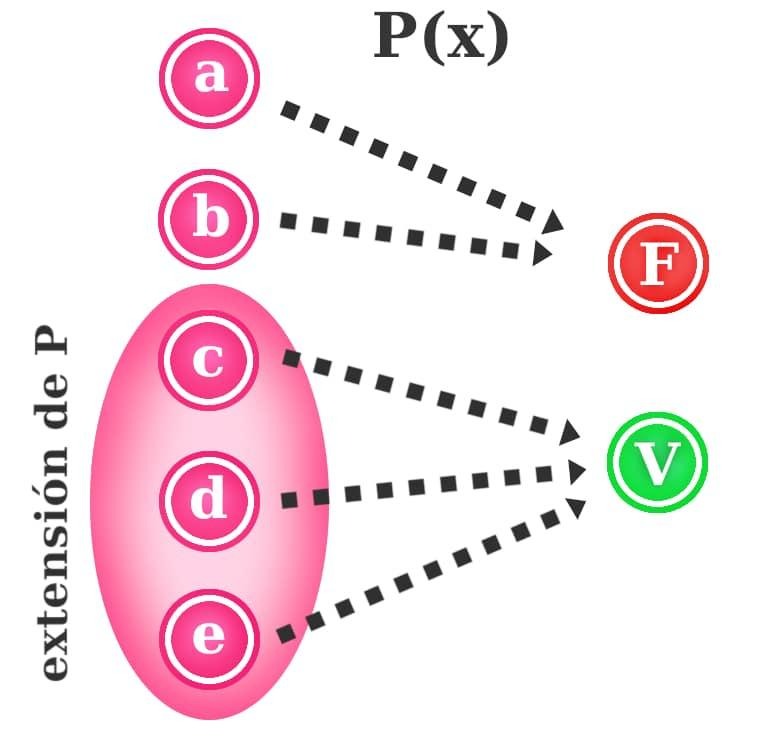
An extension is ultimately a notion close to that of a set: both define a collection of elements taken as a bounded whole. Using the modern notation of Set Theory, we may define a set \(P\) from a Fregean concept such as \(x^2 = 16\) such that
The set so defined contains two elements: \(4\) and \(-4\).
Even so, Frege’s logical principles attribute properties to extensions that do not simply coincide with those of sets in later set theory. We will examine these differences below.
Basic Law V
A concept always determines an extension. This is the so-called Principle of Comprehension. Frege develops this notion of extension and uses it to replace Hume’s Principle in his account of numbers. Combining Frege’s notation for extensions with modern logical language, we may formulate an identity criterion for extensions:
This principle, known in Frege’s logical system as Basic Law V, states that if two extensions \(\varepsilon F\) and \(\varepsilon P\) are equal, then the objects falling under one concept are exactly the same as those falling under the other. This applies even to concepts under which no object falls, such as “\(x\) is a round square.” We say that such extensions are empty. In the next article, we will see that this apparently innocuous law would bring Frege’s entire project to ruin. Before doing so, however, let us examine its implications.
Extensions and Numbers
Frege appeals to the notion of extension in order to provide an explicit definition of numbers as objects. He no longer limits himself, through Hume’s Principle, to establishing when two numerical expressions designate the same thing, but instead attempts to identify which object is the number belonging to each concept. He defines the number belonging to a concept \(F\) as the extension of a second-order concept, “\(X\) is equinumerous with \(F\),” where \(X\) is understood as an indeterminate concept. Intuitively, this object may be understood as the complete class of all concepts equinumerous with \(F\): that is, all concepts \(X\) for which this second-order concept returns “true.” These concepts \(X\) belong to that class, but they are not individually identical with the number; the number is identified with the complete class. Every number is therefore an extension collecting concepts that are equinumerous with one another. Thus, the second-order concept “\(X\) is equinumerous with the disciples of Christ” would return “true” when supplied with first-order concepts such as “\(x\) is a constellation of the Zodiac” or “\(x\) is a month of the year.” Together, they form an extension which, by definition, constitutes the number “twelve” and can be treated as another object within the logical system.
We can see how much weight Basic Law V carries in this definition: it is what allows every equinumerous concept to be collected under a single extension. Below, we will explain how each number is defined precisely.
Basic Law V versus Hume’s Principle
Like Hume’s Principle, Basic Law V places an equality—between extensions—on one side of an equivalence. Despite their similarity, the definition by extensions resolves some of the problems affecting Hume’s Principle. Frege is not introducing an entirely novel notion. Every concept, as a particular type of function, has a domain: all the objects the function accepts as arguments, that is, all those for which it yields a value. The extension is a portion of that domain, namely those arguments for which the function returns the value true. Moreover, the extension is itself an object, readily definable and comparable with other elements of the system, thereby solving the Julius Caesar Problem.
Frege’s Arithmetic
The Numbers \(0\) and \(1\)
Following these principles, the number \(0\) is defined by means of a second-order concept asserting equinumerosity among concepts such as “\(x\) is a round square” or “\(x\) is a married bachelor”: concepts under which no object falls because they are contradictory. In terms closer to Frege’s own, every concept equinumerous with “\(x\) is not identical with itself” (\(x \neq x\)) has an associated extension, and that extension is the number \(0\).
$$0 = \varepsilon (X \mapsto X \sim (x \neq x))$$
This number \(0\) is another object in the system and may therefore serve as an argument for other first-order concepts, such as “\(x = 0\).” Exactly one object falls under this concept: the previously defined object \(0\) itself. The extension of all unitary first-order concepts, such as “\(x = 0\)” but also “\(x\) is Julius Caesar,” under each of which exactly one object falls, constitutes the number \(1\).
$$1 = \varepsilon (X \mapsto X \sim (x = 0))$$
The Ancestral
So far, we have defined a number as the extension of a second-order concept. To complete the logical definition of natural number, these numbers must be related to one another, so that we can state relations such as “\(x\) is greater than” or “\(x\) precedes.” Frege begins from a notion he developed himself and which would later become known as the ancestral. The term is intended to evoke the biological relations between ancestors and descendants, applied to the numerical sequence.
Let us begin with its formal expression. An object \(z\) has \(a\) as an ancestor with respect to a relation \(R\) if it satisfies every property \(P\) meeting two conditions:
- \(a\) satisfies \(P\): \(P(a)\).
- For any objects \(x\) and \(y\), if \(P(x)\) and \(R(x,y)\), then \(P(y)\).
Using the modern language of second-order logic, \(a\) is an ancestor of \(z\) with respect to \(R\) if:
$$\forall P\Bigl[\bigl(P(a)\land \forall x\forall y\bigl((P(x)\land R(x,y))\rightarrow P(y)\bigr)\bigr)\rightarrow P(z)\Bigr]$$
This statement says that an object \(z\) has \(a\) as an ancestor if it satisfies every hereditary property satisfied by \(a\). A property is hereditary with respect to \(R\) when, if \(P(x)\) and the relation \(R(x,y)\) holds, then \(y\) also satisfies \(P\). In other words, \(a\) is an ancestor of \(z\) if \(z\) is either \(a\) itself or one of its descendants.
The Natural Numbers
An ancestral relation depends both on the relation \(R(x,y)\) and on the primordial element \(a\). If, for example, \(R(x,y)\) means that “\(x\) is the father of \(y\)” and we stipulate that \(a\) is one of \(z\)’s great-great-grandfathers, we may interpret this ancestral relation as linking \(a\) to all of his descendants, including \(z\). After all, the definition of “ancestor” involves a series of inheritable properties, such as sharing a surname or the existence of genetic ties.
For the definition of the natural numbers, however, we are obviously interested in a different kind of relation and a different primordial element. Frege proposes \(S(x,y)=\) “\(y\) is the successor of \(x\).” For \(y\) to be the successor of \(x\) means that \(y\) is the number of a concept obtained by adding one new object to another concept whose number is \(x\). The primordial element can be none other than the number \(0\).
$$N(z)\leftrightarrow\forall P\left[\left(P(0)\land\forall x\forall y\bigl((P(x)\land S(x,y))\rightarrow P(y)\bigr)\right)\rightarrow P(z)\right]$$
All objects that satisfy every hereditary property \(P\) satisfied by \(0\) under the relation “being the successor of” form a single class: the class of natural numbers.
Conclusion
From these principles, Gottlob Frege would derive several of the principal theorems of Arithmetic, including the Peano Axioms defining the natural numbers. Frege thus sought to integrate mathematics with logic and to ground its theorems in general forms of reasoning that also apply throughout logical and rational discourse.
His ambitions, however, collapsed shortly before the publication of the second volume of the Grundgesetze. Bertrand Russell discovered a devastating contradiction in Frege’s system: what is now known as Russell’s Paradox. This will be the subject of our next article.
Recommended Reading
– Stanford Encyclopedia of Philosophy. Frege’s Theorem and Foundations for Arithmetic.
– Frege, G. (1953). The Foundations of Arithmetic: A Logico-Mathematical Enquiry into the Concept of Number. Translated by J. L. Austin.
– Frege, G. (2013). Basic Laws of Arithmetic. Edited and translated by P. A. Ebert and M. Rossberg.