Irrational and real numbers
Although the idea of number is as old as humanity itself, its treatment from a strictly mathematical perspective is a relatively modern development. Precisely because of its elemental, primitive nature, the concept of number has always managed to elude mathematical formalisms. The discovery of irrational numbers added yet another layer to this confusion.
The nature of numbers
Arithmetic and Geometry are the branches of Mathematics with the longest historical tradition. Their origins as sciences grounded in rigorous principles can be traced back to Ancient Greece or even earlier. Initially, the two fields were inseparable. Numbers could be expressed as spatial magnitudes and vice versa. Pythagoras and his followers attributed a metaphysical and sacred character to numbers, elevating mathematical knowledge to a mystical and religious experience. Numbers existed beyond the physical world, yet they were the principle underlying all reality, expressed through the harmony of nature.
Numbers and operations
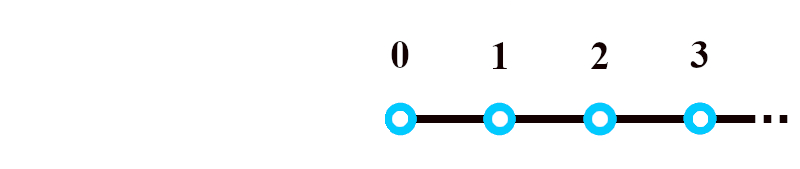
The intuitive idea of a number is closely linked to the act of counting, of following a sequence. From this simple act arises the first arithmetic operation: the sum, or addition, which is simply a composition of the act of counting. Through addition, we can therefore generate each and every one of the infinitely many natural numbers: the positive integers and zero, written in mathematical notation as \(\mathbb{N}=\left\{ 0,1,2,3,4, \cdots \right\}\). From addition we construct multiplication: a simultaneous combination of sums. These two operations are closed on the natural numbers, meaning that whenever we operate on natural numbers, the result is also a natural number.
Integers
The inverse operations broaden our numerical horizon because they generate new sets of numbers. Applying subtraction to the natural numbers gives rise to the negative integers (\(-1, \, -2, \, -3, \, -4, \cdots\)). For centuries, these numbers were disregarded because of a certain prejudice that tied numbers to spatial magnitudes. It makes no sense to speak of a length of \(-4\), and their use therefore did not become widespread—at least in the European mathematical tradition—until the sixteenth century, when mathematicians began to overcome the conceptual barrier that prevented them from viewing Mathematics as a science extending beyond spatial magnitudes. Today they are fully accepted and, together with the natural numbers, form the set known as the integers (\(\mathbb{Z}\)).

Rational numbers
The inverse of multiplication is division, which produces a ratio. This operation has been known since time immemorial and, like subtraction, gives us a new number set beyond the integers. These are the rational numbers \(\mathbb{Q}\): all numbers that can be obtained by dividing one integer by another. This set includes both natural numbers, such as \(\frac{36}{1}\), and what we commonly call decimal numbers: they can be expressed either as a ratio (\(\frac{7}{2}\)) or as a decimal (\(3.5\)). If we consider the number line, we see that the natural numbers extend from \(0\) to infinity, while the negative integers extend from \(-1\) toward negative infinity. The rational numbers encompass both the integers and the spaces between them. Between any two consecutive integers, there are infinitely many rational numbers.
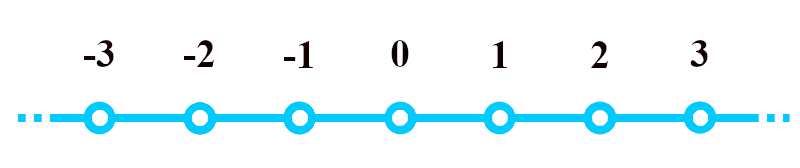
This property is simply a consequence of the infinitude of the integers themselves. As the denominator increases, the resulting rational number becomes smaller and smaller.
Irrational numbers
Once rational numbers have been established, we might think that the entire numerical domain has already been covered. Infinity extends both toward increasingly large magnitudes and toward increasingly small ones. But there is more. In fact, infinitely more.
The discovery of irrational numbers takes us back to the Pythagorean school. As noted earlier, Mathematics at that time was subordinate to the study of spatial magnitudes that could be constructed geometrically. Numerical quantities were expressed through ratios between line segments. Doubling a magnitude of any size suggested the number two. Dividing that magnitude into two equal sections was associated with one half. Such ratios were independent of the measurement system being used.
The square root of 2
Hippasus of Metapontum, a disciple of Pythagoras, would undermine the fundamental doctrine of his own school, which held that the natural numbers—the positive integers together with \(0\)—were the foundation of all reality. Hippasus demonstrated that there were quantities that could not be expressed using natural numbers, or even rational numbers. One such number is . If we take a square whose sides have length one, the Pythagorean theorem itself tells us that its diagonal has length .
$$a^2 + b^2 = c^2$$
$$1^2 + 1^2 = 2$$
$$c^2 = 2$$
$$c = \sqrt{2}$$
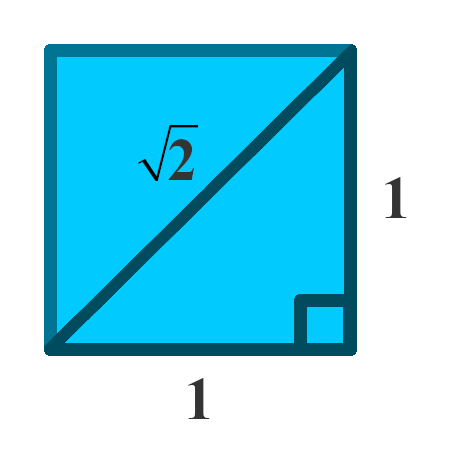
Legend has it that the proof of the incommensurability of this quantity angered the Pythagoreans so greatly that, during one of their voyages, they killed Hippasus by throwing him overboard. If we examine this number, we find that the decimal expansion of is infinite and non-repeating: there is no finite sequence of digits that repeats.
$$\sqrt2 = 1.142857142857…$$
We cannot express it fully as a decimal. However, this alone is not a defining feature of irrational numbers. Some rational numbers also have infinite decimal expansions. For example:
$$\frac{1}{7} = 0.1428571428…$$
What makes irrational numbers distinctive is that they evade every attempt to capture them using ordinary integers. The arithmetic operations of addition, division and subtraction, which allowed us to “reach” every rational number from the natural numbers, are no longer sufficient here.
Proof of the irrationality of
The renowned mathematician H. G. Hardy wrote that two mathematical proofs, through their simplicity and immense significance, displayed the sublime beauty of mathematics more clearly than any others. One of these proofs established the infinitude of the prime numbers. The second is the one presented here: the irrationality of .
The proof uses the method of reductio ad absurdum, or proof by contradiction: we assume the opposite of what we want to prove and show that this assumption leads to an unavoidable contradiction. Accordingly, suppose that is indeed a rational number. By definition, this would imply that there must be two natural numbers other than \(0\), \(a\) and \(b\), such that \(\frac{a}{b}=\sqrt{2}\).
Let us assume that the fraction \(\frac{a}{b}\) is in lowest terms. In other words, its numerator and denominator cannot have a common divisor, because otherwise the fraction could be reduced further. For example, \(\frac{21}{6}\) reduces to \(\frac{7}{2}\) because both numerator and denominator share \(3\) as a common divisor. Every rational number has a unique fraction of natural numbers in lowest terms.
$$\frac{a}{b} = \sqrt{2}$$
$$\frac{a^{2}}{b^{2}} = 2$$
$$a^{2}= 2b^{2}$$
We conclude that \(a^2\) is equal to a number multiplied by two. This is equivalent to saying that \(a^2\) is even and, by a property of squares, that \(a\) is also even. By the definition of parity, we may therefore express \(a\) as some number \(p\) multiplied by \(2\). We can then continue the argument:
$$(2p)^2= 2b^{2}$$
$$4p^2= 2b^{2}$$
$$2p^2= b^{2}$$
We conclude that \(b^2\), and therefore \(b\), is an even number. This means that \(\frac{a}{b} = \sqrt{2} = \frac{2p}{2q}\). Fractions whose numerator and denominator are both even can be reduced because they share the common divisor 2. We have now found the contradiction we were seeking, since our premise was that the fraction \(\frac{a}{b}\) was already in lowest terms. We must therefore reject the initial hypothesis that \(\sqrt{2}\) is a rational number obtained by dividing two integers. Thus, this number is irrational.
Real numbers
The set comprising the rational and irrational numbers is known as the set of real numbers \(\mathbb{R}\).
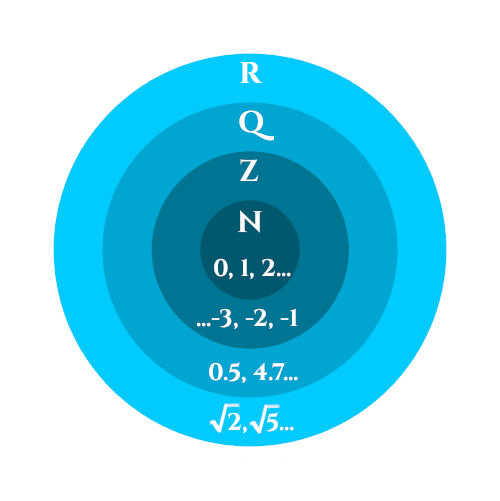
We say that the rational numbers are dense: no matter how small the difference between two distinct rational numbers may be, infinitely many other rational numbers lie between them. However, the existence of irrational numbers means that the rational numbers do not include every possible number on the real number line. Metaphorically speaking, there are gaps that cannot be filled, and moving through the rational numbers would involve proceeding in jumps. The apparently complete rational number line contains discontinuities.
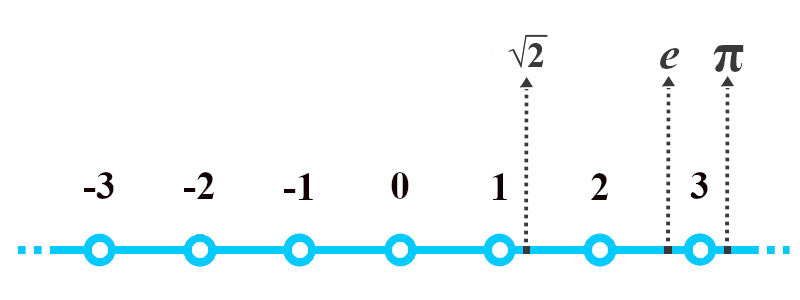
By contrast, the real number line does exhibit continuity. The question of how many real numbers exist—that is, rational and irrational numbers—is one of the motivations behind the whole of Set Theory, which emerged in the late nineteenth century through the work of Georg Cantor and will be the subject of the articles that follow.
The phenomenon of continuity
Defining the irrational numbers is a difficult task. For the sets of natural and rational numbers, it was sufficient to apply the fundamental arithmetic operations of addition, multiplication, subtraction and division. The nature of irrational numbers, however, prevents us from following the same steps. None of these arithmetic operations, when applied to any rational numbers, produces an irrational number. Irrational numbers are therefore unreachable by these means. As we have seen, they first emerged not from Arithmetic but from Geometry. Defining the complete set of real numbers therefore requires methods that are less familiar and more complex than those considered so far. Historically, in fact, such definitions did not appear until the second half of the nineteenth century. In the articles that follow, we will explore the strange properties of the mathematical continuum. To do so, however, we must first examine a subject that has astonished and unsettled mathematicians since the beginning of time: infinity.