Paradoxes of the Infinite
The early studies of perspective that emerged during the Renaissance introduced the concept of the vanishing point—or the point of convergence for parallel lines—a point that, geometrically, is situated at infinity. In this article, we will explore some of the most paradoxical and unusual properties of mathematical infinity.
Problems of Infinity
Most of mathematics’ great paradoxes involve infinity in one way or another. It has therefore long been a source of unease for rational minds. Many avoided the issue altogether, refusing to treat it with the necessary formality. From the nineteenth century onward, with the arithmetization of analysis and, later, set theory, infinity received increasingly rigorous mathematical treatments. This article is the first of several devoted to the mathematical notion of infinity. Here we will present some of the paradoxes that have arisen in connection with infinity and the possible solutions that have been proposed. The title of this article is taken from the work Paradoxes of the Infinite by Bernard Bolzano, a mid-nineteenth-century mathematician who pioneered a rigorous treatment of the notion of mathematical infinity.
Distinguishing Infinities
We will now examine an example of just how confusing infinity can be. Within the modern framework of Analysis, these operations with infinite series would not be meaningful, but here we are seeking an intuitive approach to the problem. Consider the infinite sum of all the numbers, which we will call \(S_{1}\):
$$S_{1} = 1 + 2+ 3 +4 +5 \dots$$
Now compare it with the sum of all the numbers starting from a given one, for example, \(8\). This series contains every term of the previous series except the first seven, so it is only a part of \(S_{1}\):
$$S_{8} = 8 + 9+ 10 +11 +12 \dots$$
We might think that the first series is greater than the second. Moreover, there would appear to be a finite difference between them.
$$S_1 – S_8 = 1+2+3+4+5+6+7 = 28$$
But it is also true that, if we pair each term of one series in order with its counterpart in the other series (\(1\) with \(8\), \(2\) with \(9\), and so on), we see that the terms appearing in \(S_{8}\) are always greater. For finite sums with the same number of terms, if every term in one series is greater than the corresponding term in the other, then that sum is necessarily greater. Therefore, if we regard our series as having the same number of terms—infinitely many—we would reach the opposite conclusion from the first line of reasoning: the second series is greater than the first.
How can this contradiction be resolved? Clearly, strategies that are valid for finite sets are not necessarily valid when we are dealing with infinitely many elements. We will need another method for comparing infinite sets.
The Whole and Its Parts
One of our clearest and most compelling intuitions is that the whole is greater than any of its parts. It seems obvious that a line segment formed by joining three smaller segments must be greater than any one of those three parts. But this holds only in the domain of finite magnitudes. We will see that one of the most striking paradoxes of mathematical infinity is precisely that it defies this logical principle.
Points on a Line
A line is often described intuitively as being made up of infinitely many points. We will see that this has remarkable consequences.
Place two segments on the same line, \(ab\) and \(ac\), with the second having greater length. Let \(x\) be any point on \(ab\). We can define an algebraic relationship that associates every point \(x\) on \(ab\) with exactly one point \(y\) on \(ac\).

For example, suppose that \(ab\) has length \(7\) and \(ac\) has length \(12\), so that the same proportion is preserved between corresponding points on the two segments.
$$\frac{x}{7} = \frac{y}{12}$$
In this way, each point \(x\) on \(ab\) corresponds unambiguously to a point \(y\) on \(ac\). For example, if \(x\) were \(5\):
$$\frac{5}{7} = \frac{y}{12}$$
$$12(\frac{5}{7}) = y$$
$$y \approx 8.5714$$
But the converse is also true: for every \(y\) there is exactly one point \(x\) on \(ab\). In other words, every point on one segment has a counterpart on the other; equivalently, both segments contain the same number of points, even though they have different lengths. This is paradoxical. Although the points of the segment \(ab\) are also part of the longer segment \(ac\), the two segments nevertheless contain the same number of points. This remains true regardless of their lengths.
Pairing Elements
The previous example reveals one of the most striking properties of infinite sets: a part of an infinite set can have the same size as the whole. Our initial attempt to compare infinite series led to an outright contradiction. Mathematics rejects contradictions of every kind. Counterintuitive results, however, are entirely permissible. This method of pairing elements, despite leading to paradoxical consequences, is the path we must follow when exploring mathematical infinity.
Mappings
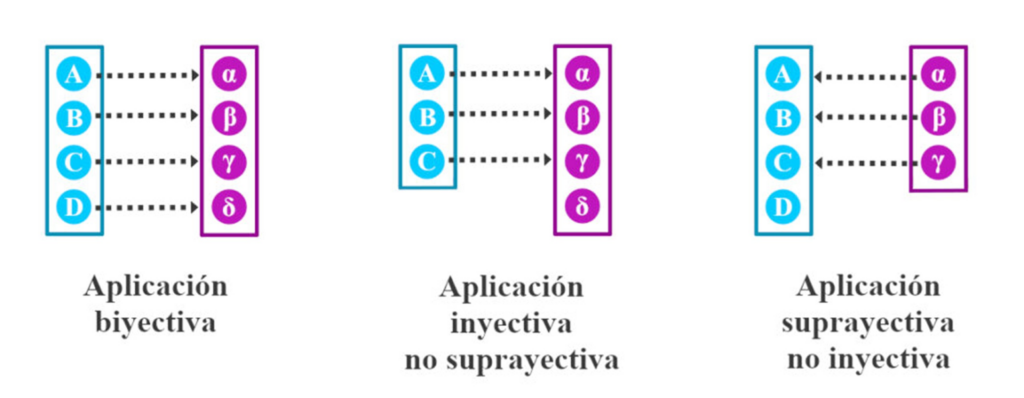
In mathematics, a mapping is a correspondence or pairing between the elements of two sets. Each element may be associated with only one element of the other set. Mapping and function are equivalent concepts, although we will reserve the term function for cases in which there is an algebraic relationship between the sets.
Since it is impossible to count how many elements make up an infinite set, mathematicians have repeatedly relied on this strategy of pairing elements. Two sets are considered to have the same size if every element of one is associated with exactly one element of the other, and vice versa, with no element left unmatched. This procedure is known as a bijective mapping and is equally valid for finite and infinite sets.
Defining Infinity
This property is reflected in number systems. Galileo famously observed that each of the infinitely many natural numbers could be paired uniquely with its square. This operation could be continued indefinitely, producing two paired sets, both infinite. Yet although both are infinite, the set of squares does not contain every natural number, but only a subset of them.
$$1 \longrightarrow 1$$
$$2 \longrightarrow 4$$
$$3 \longrightarrow 9$$
$$4 \longrightarrow 16$$
The same could be said of the infinite sets of even or odd numbers. Once again, they are proper subsets that do not contain every element of the original set, yet have the same cardinality. Many mathematicians have regarded this property—the possibility of establishing a bijection with a proper subset—as the defining characteristic of every infinite set, such as the set of natural numbers.
Arithmetic of Infinity
Zeno and Infinity
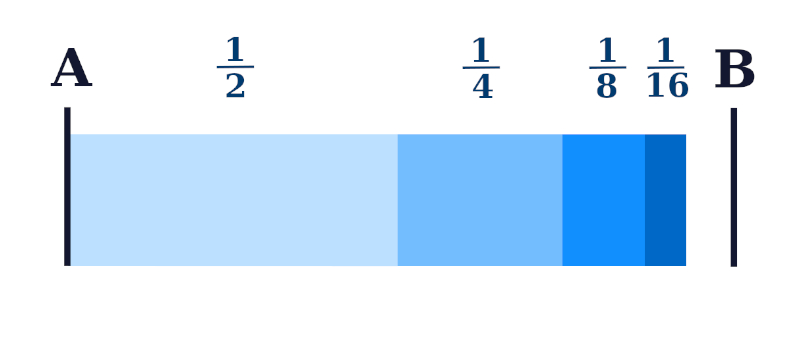
One of the most famous paradoxes involving infinity is attributed to the Greek thinker Zeno and concerns an uneven race between the hero Achilles and a tortoise. In this race, Achilles gives the tortoise a head start. At first glance, Achilles’ greater speed means that, regardless of the lead granted to the tortoise, he will eventually overtake it. Yet this apparently obvious argument conceals a paradox. To traverse any distance, one must first cover half of it. Reaching that halfway point, in turn, requires first covering half of that distance, and so on through ever smaller intervals. Consequently, no matter how short the distance to be covered, Achilles would have to complete an endless number of steps and would therefore never reach his goal.
Mathematical Series
This paradox illustrates how logic can sometimes lead us astray. Although resolving it is not straightforward, mathematical advances beginning in the seventeenth century made it possible to treat processes involving the sum of infinitely many steps. In mathematics, an infinite series is the sum of the infinitely many terms of a sequence. The distance travelled by Achilles, as we have described it, could be modelled by the series:
$$\frac{1}{2} + \frac{1}{4} + \frac{1}{8} + \frac{1}{16} + \frac{1}{32} \cdots$$
The Greeks believed that a sum of infinitely many terms, however small those terms might be, must itself be infinite. Contrary to what intuition may suggest, an infinite sum—such as the one we are considering—does not always grow without bound. This was not formally understood until two thousand years after Zeno.
Convergent Series
This article is not intended to introduce the mathematical notion of a limit. Here, we will define the limit as the value approached by an infinite sum as its terms are added one by one, and therefore regarded as the final value of the entire infinite series. Many such series do not result in an infinite magnitude. They are called convergent series when the limit of the sum converges to a precise point on the real number line. The preceding series of successive halves is a type of geometric series defined as:
provided that \(\left| r \right|<1\). In the case of Achilles’ race, \(a = \frac{1}{2}\) and \(r = \frac{1}{2}\). Thus, the first term is \(\frac{1}{2}(\frac{1}{2})^0 = \frac{1}{2}\).
Proof
We will now prove that Achilles’ infinite series has a sum of \(1\). This illustrates how an infinite sum can be evaluated without adding infinitely many terms individually. Let the complete sum be \(S\). If we multiply every term in the series by \(\frac{1}{2}\), we see that the resulting sum is equivalent to removing the first term from the original series:
$$\frac{1}{2}S = \frac{1}{4} + \frac{1}{8} + \frac{1}{16} + \frac{1}{32} \cdots$$
The difference between the two series, \(S\) and \(\frac{1}{2}S\), is therefore one half:
$$S – \frac{1}{2}S = \frac{1}{2}$$
$$\frac{1}{2}S = \frac{1}{2}$$
$$S= 1$$
Although this is an infinite sum, we have shown that its value converges to \(1\).
These unusual properties of mathematical infinity led many mathematicians, including several of great renown, to be cautious or critical of certain forms of actual infinity. Actual infinity means infinity conceived as a complete and given totality, rather than merely as a process that can be continued indefinitely. For example, we may speak of the natural numbers as a sequence that can be extended without limit, which fits the interpretation of potential infinity, but also as an infinite set—a mathematical object considered as a whole—which brings us closer to the interpretation of actual infinity. This latter idea proved problematic because it appears to contradict deeply rooted intuitions about quantity and size. Before a rigorous theory of infinite sets existed, it was unclear which operations could legitimately be performed on such infinite totalities without falling into contradictions or misleading arguments. In the following articles, however, we will encounter a thinker who discovered how to deal with mathematical infinity. That thinker was Georg Cantor, to whom our next articles will be devoted.
Recommended Reading
- Bolzano, B. (1851) Paradoxes of the Infinite.