Transfinite Numbers
Cantor’s work did not end with ordinals. He discovered an entire hierarchy of infinities, some larger than others. He termed them transfinite numbers and designated them with the Hebrew letter aleph. In doing so, Cantor reaffirmed the link between his mathematical research and the experience of closeness to the divine.
Cardinal Numbers
Let us review what we saw in the previous article. Cantor distinguished between ordinal and cardinal numbers. This distinction becomes apparent only for infinite sets such as the natural numbers, from which we can construct infinitely many sequences with different order types. However, this does not change the number of elements, or cardinality, of the set. Are there infinities with a greater number of elements—that is, with a cardinality greater than that of the natural numbers? In this article, we will show that there are.
As we saw previously, cardinality is a property that arises when we establish pairings between the elements of two sets, regardless of how those elements are ordered. If every element of one set is paired with exactly one element of the other, and no element of either set is left out, then we have a bijection.
Intuitively, cardinality is simply the number of elements in a set. Consequently, if a bijection can be established between two sets—that is, if they are equipotent—then both sets contain the same number of elements. Establishing a bijection is not always possible, which corresponds to sets with different cardinalities. Cantor called the numerical expression of this cardinality a cardinal number.
Arithmetic Operations on Cardinals
Because he treated them as “numbers,” Cantor defined arithmetic operations that could be applied to these cardinals. Unsurprisingly, these definitions are formulated in terms of sets and their elements. For a given set \(A\), we will denote its cardinality by \(\left[A\right]\).
These cardinals can be added or multiplied, but exponentiation will be of particular interest for the purposes of this article. Given two sets \(A\) and \(B\), Cantor defined the operation \(\left[ B \right]^{\left[ A \right]}\) as the number of possible mappings from \(A\) to \(B\). Let us consider an example involving finite sets. Given two sets
\(A=\left\{ \alpha, \beta, \gamma \right\}\), with cardinality \(\left[ A \right]=2\)
\(B=\left\{ a,b,c \right\}\), with cardinality \(\left[ B \right]=3\)
\(\left[ B \right]^{\left[ A \right]}=8\), since there are nine possible mappings from \(A\) to \(B\), namely:
\(α ⇒a \qquad β⇒a\)
\(α ⇒b \qquad β⇒b\)
\(α ⇒c \qquad β⇒c\)
\(α ⇒a \qquad β⇒b\)
\(α ⇒b \qquad β⇒a\)
\(α ⇒a \qquad β⇒c\)
\(α ⇒c \qquad β⇒a\)
\(α ⇒b \qquad β⇒c\)
\(α ⇒c \qquad β⇒b\)
We can see that this operation corresponds to the familiar notion of exponentiation.
Cantor’s Theorem
Cantor’s Theorem is a fundamental result in set theory. It is the proposition that opens the door to the different infinities that characterize Cantor’s work: the transfinite numbers.
Power Set
We are familiar with the claim that, given a collection of objects, the number of possible combinations of those objects is greater than the number of objects themselves. Thus, given the set \(A=\left\{ a,b,c \right\}\) we can form the subsets \(\left\{ a \right\}\), \(\left\{ b \right\}\), \(\left\{ c \right\}\), \(\left\{ a,b \right\}\), \(\left\{ a,c \right\}\), \(\left\{ b,c \right\}\), \(\left\{ a,b,c \right\}\) and \( \emptyset \) which together form a single set (including the full set and the empty set). We call this set of subsets the power set or \(\mathcal{P}A\).
We can see that the first set has cardinality \(\left[ A \right]=3 \), whereas the second has cardinality \(\left[\mathcal{P}A \right]=8 \). Cantor’s Theorem states that the number of elements in a power set is greater than the number of elements in the set itself, as this example shows.
$$\left[ A \right] \lt \left[\mathcal{P}A \right]$$
What makes this result particularly interesting is that it generalizes to infinite sets. Given a set equipotent to the set of natural numbers, its power set will clearly be infinite, but it will be a larger infinity. We will now prove this.
Subsets and Binary Strings
Before introducing the proof, we will establish the equivalence between the power set and exponentiation. Given two finite sets, one of cardinality 2, such as the binary set \(B=\left\{ 0,1 \right\}\), and the set \(A=\left\{ \alpha, \beta, \gamma \right\}\), we will show that the cardinality of the power set of \(A\) is equal to \(\left[ B \right]^{\left[ A \right]}\), or equivalently, \(2^{\left[ A \right]}=8\). As we saw earlier, \(\left[ B \right]^{\left[ A \right]}\) is equal to the number of mappings from \(A\) to \(B\), namely eight mappings.
\(\alpha ⇒0 \qquad \beta⇒0\ \qquad \gamma⇒0\)
\(\alpha ⇒1 \qquad \beta⇒0\ \qquad \gamma⇒0\)
\(\alpha ⇒0 \qquad \beta⇒1\ \qquad \gamma⇒0\)
\(\alpha ⇒0 \qquad \beta⇒0\ \qquad \gamma⇒1\)
\(\alpha ⇒1 \qquad \beta⇒1\ \qquad \gamma⇒0\)
\(\alpha ⇒1 \qquad \beta⇒0\ \qquad \gamma⇒1\)
\(\alpha ⇒0 \qquad \beta⇒1\ \qquad \gamma⇒1\)
\(\alpha ⇒1 \qquad \beta⇒1\ \qquad \gamma⇒1\)
Each of them corresponds to a string of \(1\)s and \(0\)s:
\(000\)
\(100\)
\(010\)
\(001\)
\(110\)
\(101\)
\(011\)
\(111\)
These, in turn, correspond to the subsets of the set \(A\), if we take \(0\) to indicate the absence of an element and \(1\) to indicate its presence:
\(\emptyset \)
\(\left\{ \alpha\right\}\)
\(\left\{ \beta \right\}\)
\(\left\{\gamma \right\}\)
\(\left\{ \alpha, \beta \right\}\)
\(\left\{ \alpha, \gamma \right\}\)
\(\left\{\beta, \gamma \right\}\)
\(\left\{ \alpha, \beta, \gamma \right\}\)
Infinite Subsets
The previous example involved a finite set, but the correspondence we used does not depend on whether the set has three, four, or any other number of elements. The general idea is this: every subset of \(A\) corresponds to a mapping from \(A\) to \(\left\{0,1\right\}\), where \(1\) indicates that an element belongs to the subset and \(0\) indicates that it does not. Conversely, every mapping from \(A\) to \(\left\{0,1\right\}\) determines a unique subset of \(A\).
Therefore, even for infinite sets, the power set of \(A\) has the same cardinality as the set of mappings from \(A\) to \(\left\{0,1\right\}\):
$$\left[\mathcal{P}A \right] = 2^{\left[A \right]}$$
This equivalence is therefore equally valid for the natural numbers \(\mathbb{N}=\left\{ 1, 2, 3, 4, \cdots \right\}\):
$$\left[\mathcal{P}\mathbb{N} \right] = 2^{\left[ \mathbb{N} \right]}$$
The difference is that the mapping now produces every possible infinite string of \(0\)s and \(1\)s, or equivalently, every mapping \( \mathbb{N} \to \left\{0,1\right\}\). The number of such strings is clearly infinite, but what we will now prove, in accordance with Cantor’s Theorem, is that this infinity is greater than \(\left[ \omega \right]\).
Cantor’s Diagonal Argument
Cantor achieved lasting fame for his diagonalization proof. Although he was not the first to use this method and employed it only in his later works, it is the gateway through which many people encounter Cantor’s ideas, to the point that it has become known as Cantor’s diagonal argument. Seldom in the history of mathematics has such a simple proof had such profound significance.
Like many other proofs, it is based on proof by contradiction: we begin with the hypothesis that a set equipotent to the natural numbers and its power set have the same cardinality, and this assumption will lead us to a contradiction that invalidates the original premise.
Infinite Matrix
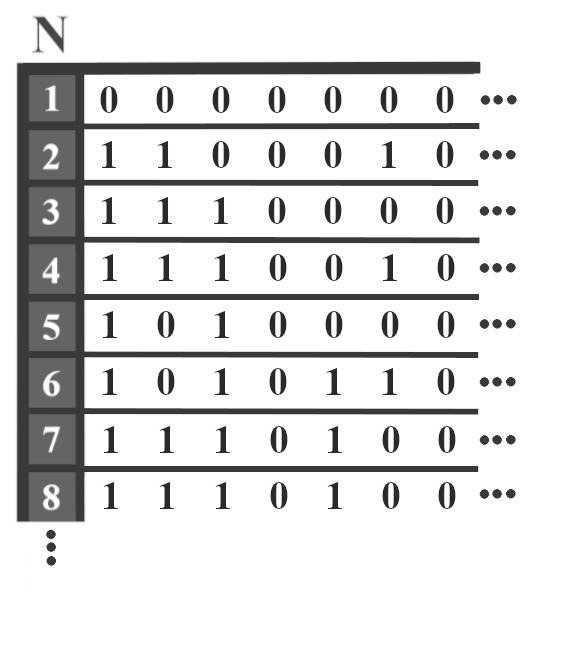
The idea is simple. If the two sets had the same cardinality, then by definition it would be possible to establish a bijection between them, pairing their elements without leaving any element unmatched. We established earlier that the subsets of \(\mathbb{N}\) are equivalent to infinite strings of \(0\)s and \(1\)s. Let us therefore associate each infinite string with a natural number, which we will call its index. If such a bijection could be established, every possible string would appear in a matrix like the one shown in the image, indexed by a natural number.
The key point is that, for any matrix we construct, we can generate a string that is not contained in it. To find it, we need only generate a new string whose first digit is \(1\) if the first digit of the first string is \(0\), and vice versa. Its second digit will likewise be \(1\) or \(0\) if the second digit of the second string is \(0\) or \(1\), respectively. We continue in this way, moving diagonally through the infinite matrix.
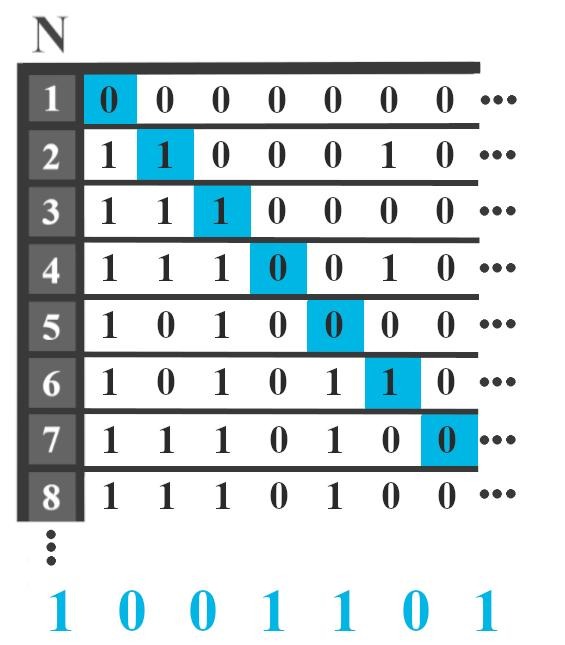
Because the new string differs in at least one position from every other string in the list, it cannot appear in that list, however infinite the list may be. For every possible ordering of the strings in the matrix, the “new string” will be different, but one will always exist. We therefore conclude that the natural numbers cannot enumerate all the subsets of a set with cardinality \(\left[ \mathbb{N} \right]\). There will always be an unmatched subset outside the indexing.
We therefore conclude that Cantor’s Theorem, as applied to the infinity of the natural numbers, can be summarized as follows:
$$\left[\mathcal{P} \mathbb{N} \right] \gt \left[\mathbb{N} \right]$$
The Alephs
By means of the power set and cardinal exponentiation, we have generated a new type of infinite cardinal. In doing so, we have asserted nothing less than the existence of two different infinities, one greater than the other. Cantor called these different infinities transfinite numbers. In his later works, Cantor introduced the symbol \(\aleph\) to denote these transfinite cardinals: the Hebrew letter aleph. Cantor was a man of deep religious conviction, and his mathematics rarely appears entirely separate from metaphysics. A Christian, though believed to have had Jewish ancestry, he is thought to have chosen this letter because it is the first letter of the term איןסוף, Ein Soph, “the boundless,” the pre-existing divine principle from which the world originates in Kabbalistic mysticism. The gesture suited the ambition of his theory. The very idea of infinity, defined precisely by our inability to bound it, fits perfectly with this reference to the Kabbalah. His theory of infinity sought to show that where tradition saw an inconceivable abyss, reason could discover structure, hierarchy, and number.
Thus, alongside the first transfinite ordinal, which in the previous article we denoted by \(\left[\omega\right]\), we now introduce \(\aleph_{0}\) or “aleph-null,” the smallest transfinite cardinal number.
Aleph Infinities
In the previous article, we saw that a set of a given cardinality—the cardinality of the natural numbers, or \(\aleph_{0}\)—contained infinitely many order types, or ordinals. No matter how many times we added or multiplied ordinals, the resulting set never had a cardinality greater than \(\aleph_{0}\). The new cardinality, \(2^{\aleph_{0}}\), however, is strictly greater.
$$2^{\aleph_{0}} > \aleph_{0}$$
But the matter does not end there. Cantor’s Theorem applies not only to the natural numbers, but to every set. Therefore, once we have obtained the new cardinality \(2^{\aleph_0}\), we can take its power set in turn, obtaining an even greater cardinality:
$$2^{2^{\aleph_0}} \gt 2^{\aleph_0}$$
And nothing prevents us from repeating this procedure again and again. Each new power set gives rise to a greater cardinality, producing an unending hierarchy of ever-larger infinities. The exact place occupied by \(2^{\aleph_0}\) within the hierarchy of alephs will be one of the central questions associated with the continuum problem.
Each new infinite cardinality introduces not only a new “size” of set, but also opens up a new region of order types. In the Cantorian framework, if a totality of that cardinality can be well-ordered, there will be a first ordinal capable of enumerating it; from that ordinal, new ordinals can be formed through the same procedures already described: adding successors, taking limits, and extending the transfinite sequence. Just as \(\omega\) is the first ordinal associated with the cardinality of the natural numbers, a greater cardinality will also have its own initial ordinals and its own transfinite extensions. Cantor’s Theorem guarantees that we can always move to a greater cardinality by taking the power set; what remains open, however, is the exact position those new cardinalities occupy within the general hierarchy of infinities.
The Continuum Hypothesis
Cantor’s Theorem assures us that \(2^{\aleph_0}\) is a cardinality strictly greater than \(\aleph_0\). But this raises a new question: is this new cardinality the very next one? In other words, is there an infinite set whose cardinality is greater than that of the natural numbers but smaller than that of the power set of the natural numbers?
Cantor believed there was not. This is the celebrated Continuum Hypothesis: there is no intermediate cardinality between that of the natural numbers and that of \(\mathcal{P}(\mathbb{N})\). If the hypothesis were true, we could therefore identify \(2^{\aleph_0}\) with \(\aleph_1\), the next transfinite cardinal after \(\aleph_0\).
$$2^{\aleph_{0}} = \aleph_{1}$$
There is also the Generalized Continuum Hypothesis, which extends this idea to all transfinite cardinals: for every \(\aleph_{\alpha}\), the cardinality of its power set would be exactly \(\aleph_{\alpha + 1}\); equivalently, between an infinite cardinal \(\aleph_{\alpha}\) and \(2^{\aleph_{\alpha}}\) there are no intermediate cardinals.
Cantor was fully aware of this problem and regarded it as one of the central questions of his theory. From 1878 onward, he attempted to show that no intermediate cardinality exists between that of the natural numbers and that of the continuum. What Cantor could not have anticipated was the later turn the problem would take: in modern axiomatic set theory, the Continuum Hypothesis would not be decided by the standard axioms of set theory.
Conclusion
The reader may feel that Cantor’s entire transfinite theory has something illusory about it. Mathematical objects such as transfinite numbers can seem to have been pulled from a hat, born of mathematical sleight of hand. This “terrible dynasty of infinities,” as Borges called them, lies too far beyond our experience and understanding for us to take it seriously, let alone grant it an ontological status comparable to that of the natural numbers. Its existence does not seem nearly as evident or intuitive.
Readers who find themselves in this position should know that many mathematicians of Cantor’s time thought the same way. Cantor did not regard his transfinites as mere formal devices; his mathematical Platonism had a powerful theological dimension. He worked very hard to have his research recognized by the leading mathematical figures in Germany in the 1890s. But as his contemporary Max Plank once observed, science advances one funeral at a time. It was enough for the old generation to give way to a new one for Cantor’s transfinite numbers to take root and generate an entirely new debate within the mathematical community. Indeed, as we intend to show in these articles, their subsequent influence has been enormous.
Our next article will ground transfinite numbers in more “familiar” areas of mathematics: the nature of the real numbers and the continuum.
Recommended Reading
– Cantor, G. (1883). Foundations of a General Theory of Sets, in Foundations of a General Theory of Sets: Selected Writings and Correspondence, ed. José Ferreirós, Barcelona: Crítica, 2006.
– Cantor, G. (1891). “On an Elementary Question in the Theory of Manifolds.”
– Cantor, G. (1895/1897). “Contributions to the Foundations of the Theory of Transfinite Sets.”
– Torretti, R. (1998). Cantor’s Paradise: The Set-Theoretic Tradition in the Philosophy of Mathematics.
– Ferreirós, J. (1999). Labyrinth of Thought: A History of Set Theory and Its Role in Modern Mathematics.